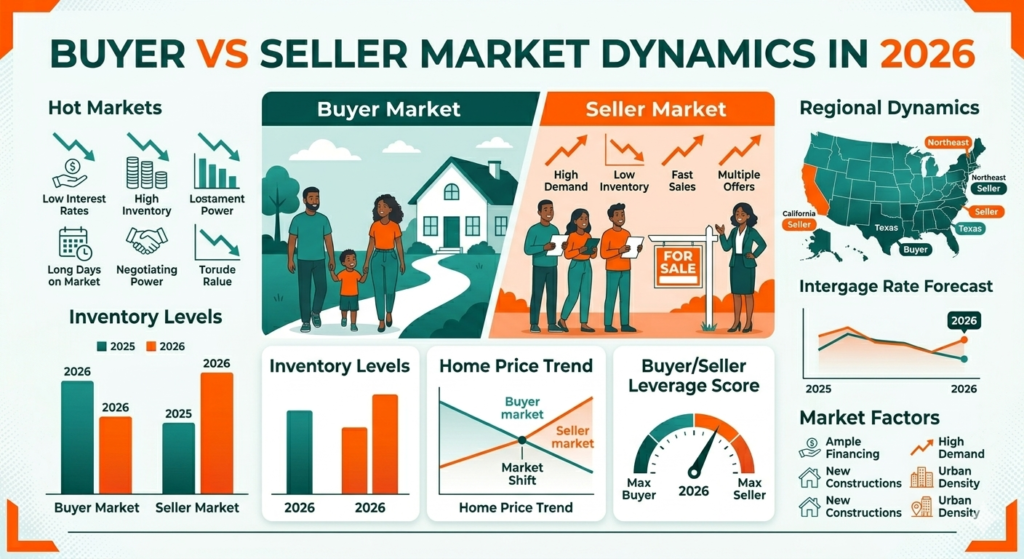
The question most people ask in 2026 is simple but complex:
Is it a buyer’s market or a seller’s market in the United States?
The answer is not black and white anymore. The U.S. housing market has become hyper-local, meaning conditions vary dramatically from one city to another.
🌎 The End of a National Market
In previous real estate cycles, you could broadly classify the entire country as either:
- Seller’s market (low supply, high demand), or
- Buyer’s market (high supply, low demand)
But in 2026, that national classification no longer works.
Instead, we see:
- Hot seller markets in supply-constrained metros
- Balanced markets in mid-tier cities
- Emerging buyer-friendly conditions in cooling suburbs
🏠 Where Sellers Still Have the Advantage
Sellers still hold power in areas where:
- Job growth is strong
- Population inflow is high
- Housing supply remains tight
In these regions:
- Homes sell relatively quickly
- Well-priced properties still receive multiple offers
- Luxury homes maintain strong demand
However, even in seller-leaning markets, bidding wars are less intense than in 2021–2022.
🧾 Where Buyers Are Gaining Power
Buyers are gaining leverage in markets where:
- Inventory has increased significantly
- Price growth has slowed or reversed slightly
- Homes are sitting longer on the market
In these areas:
- Sellers are more open to negotiation
- Price reductions are more common
- Closing incentives (repairs, credits) are increasing
This is especially true in certain suburban and secondary markets that overheated during the pandemic boom.
📊 The Balanced Market Reality
Most of the U.S. in 2026 falls into a balanced or transitional market category.
This means:
- Neither buyers nor sellers have full control
- Pricing accuracy matters more than ever
- Homes must be properly marketed and positioned
This is arguably the healthiest market condition because it reduces extreme volatility.
🧠 What Smart Buyers Are Doing
Successful buyers in 2026 are:
- Tracking price drops weekly
- Focusing on days-on-market trends
- Negotiating based on property condition, not emotion
They are no longer rushing into bidding wars. Instead, they are waiting for the right deal.
🏡 What Smart Sellers Are Doing
Smart sellers are:
- Pricing realistically from day one
- Investing in staging and presentation
- Using data-driven marketing strategies
Overpricing a home in 2026 is one of the fastest ways to lose buyer interest.
📌 Key Takeaway
The 2026 U.S. housing market is not about choosing sides — it is about understanding micro-markets. Location, pricing strategy, and timing matter more than national trends.
