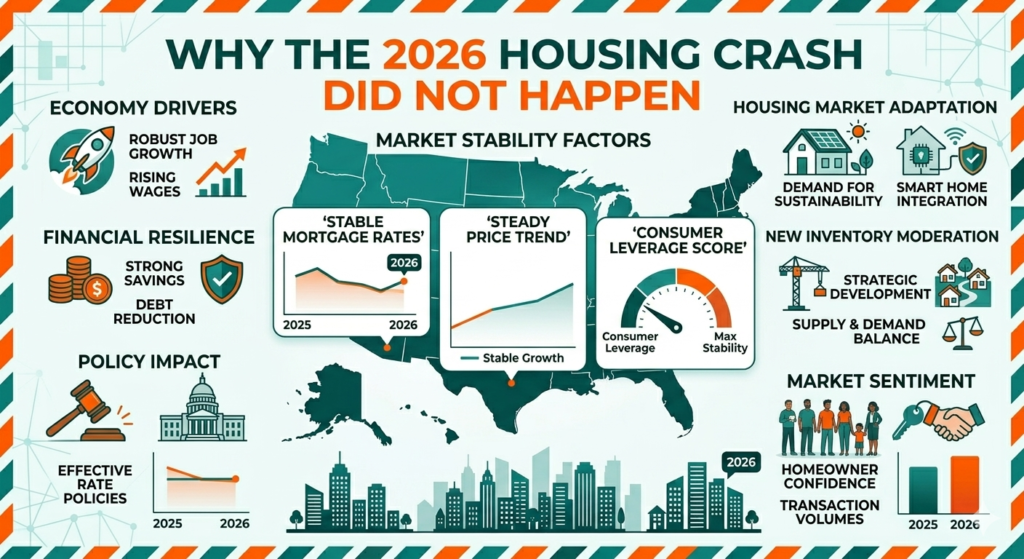
For years, predictions of a major U.S. housing crash circulated across media and social platforms. Many expected that rising interest rates and affordability issues would trigger a sharp decline.
But in 2026, the reality looks very different.
🧱 Structural Housing Shortage
The biggest reason prices did not crash is simple:
The U.S. still does not have enough homes.
Years of underbuilding, especially after the 2008 financial crisis, created a long-term supply gap. Even with increased construction in recent years, demand still outpaces supply in many regions.
💰 Homeowners Are Locked In
Another major factor is mortgage rate lock-in.
Millions of homeowners refinanced or purchased homes at historically low rates (2%–4%). Selling their homes now would mean:
- Losing low monthly payments
- Taking on significantly higher mortgage costs
As a result, many homeowners are choosing to stay put instead of selling, which limits inventory and stabilizes prices.
📊 Demand Did Not Disappear
Even though affordability has decreased, demand for housing has not collapsed. Instead:
- Millennials continue forming households
- Immigration contributes to housing demand
- Rental costs push some buyers into ownership where possible
Demand has softened, but it has not disappeared.
📉 What Actually Happened Instead of a Crash
Rather than a crash, the market experienced:
- Slower price growth
- Longer selling times
- Regional price adjustments
- Increased negotiation power for buyers
This is a soft landing scenario, not a collapse.
🧠 Market Psychology Shift
One of the most important changes in 2026 is psychological.
Buyers and sellers have adjusted expectations:
- Buyers are no longer expecting “panic discounts”
- Sellers are no longer expecting bidding wars
This alignment has helped stabilize the market.
🏠 Where Price Drops Are Happening
While there is no national crash, some localized corrections exist:
- Overpriced suburban markets
- Cities that experienced pandemic overexpansion
- Luxury segments in certain metros
However, these corrections are controlled, not systemic.
📌 Key Insight
The 2026 housing market proves a critical lesson:
A housing crash requires oversupply — and the U.S. simply does not have it.
