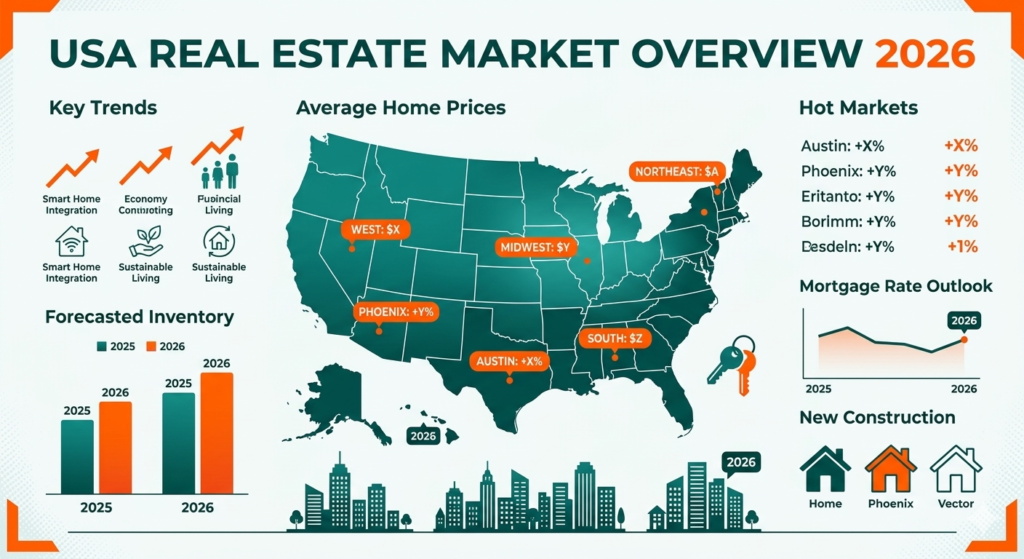
The United States real estate market in 2026 is entering a phase that many analysts describe as a “rebalancing cycle” rather than a boom or crash. After years of rapid price growth, record-low interest rates, and then a sharp correction in affordability, the market is now stabilizing into a more predictable pattern.
📊 Where the Market Stands in 2026
The most important shift in 2026 is that the housing market is no longer driven by panic buying or panic selling. Instead, it is being shaped by:
- Higher but stable mortgage rates (hovering around 6%–7%)
- Gradual increase in housing inventory
- Slower home price appreciation
- More cautious but steady buyer demand
Unlike the pandemic-era housing surge, buyers now have more time to evaluate properties, negotiate prices, and compare financing options.
🏠 Home Prices: Stabilization, Not Collapse
One of the biggest misconceptions entering 2026 was the expectation of a housing crash. That did not materialize.
Instead:
- National home prices are largely flat to mildly increasing (2%–4% annually in many areas)
- Some overheated metros are experiencing slight corrections
- Affordable markets continue to see modest appreciation due to demand
The key reason prices are holding is simple: supply remains limited in most regions. Even though construction has increased, it has not fully caught up with population growth and long-term housing shortages.
💰 Mortgage Rates and Affordability Pressure
Mortgage rates remain one of the most influential forces in 2026. While they are no longer at historic lows, they have stabilized enough for buyers to adjust expectations.
However, affordability is still a challenge:
- Monthly payments are significantly higher than pre-2020 levels
- First-time buyers are especially affected
- Many homeowners are “locked in” to low-rate mortgages from previous years
This creates a phenomenon called the “rate lock effect,” where fewer homeowners are willing to sell, limiting inventory further.
📦 Housing Supply Slowly Improving
The good news for buyers is that inventory is slowly rising.
This is happening because:
- New home construction has increased
- Some sellers are finally entering the market after waiting years
- Homes are staying longer on the market compared to 2021–2022
However, supply is still not enough to create a full buyer’s market nationwide.
🧠 What This Means for Buyers and Investors
For buyers:
- More negotiation power compared to previous years
- Better chance of seller concessions
- Less competition on listings
For investors:
- Opportunities are shifting toward undervalued suburban and secondary markets
- Rental demand remains strong due to affordability constraints
- Long-term appreciation is more realistic than quick flips
For real estate agents:
- Success depends on local expertise, not national trends
- Data-driven lead generation is more important than ever
📌 Final Insight
The 2026 real estate market is not dramatic — it is strategic. Success in this environment comes from understanding local conditions, interest rate behavior, and long-term housing demand rather than reacting to headlines.
